




What happens when your sampling container is suitable, but its material, connections or configuration do not match your bioprocess workflow?
A centrifuge tube assembly serves a purpose beyond simply containing samples.Its tube, tubing, connectors, closures and other components must work together to support the intended sampling and fluid transfer process. Choosing the right configuration can help you plan a suitable sampling setup, maintain a closed fluid path and avoid compatibility issues.
Before selecting a centrifuge tube assembly for bioprocess sampling, consider these six factors.
1. Does the Tube Capacity Match Your Sampling Volume?
Start by identifying how many samples your process requires. The tube should accommodate the intended sample volume while leaving sufficient headspace where required by the applicable process and centrifugation protocol.
Common bioprocess sampling configurations include 15 mL and 50 mL tube formats. The right option depends on sample volume, handling requirements and the downstream operation.
For smaller-volume workflows, review the 15 mL sterile centrifuge tube assembly. For larger sampling requirements, consider the 50 mL sterile centrifuge tube assembly.
Always confirm the working volume and suitability against the manufacturer's product documentation.
2. Is the Tube Material Compatible With Your Sample?
Material compatibility matters when samples contain buffers, process intermediates, reagents or other biopharmaceutical fluids.
Polypropylene (PP) is widely used in laboratory and bioprocess applications for manufacturing containers.However, material selection should not rely on the polymer name alone. Consider the chemical composition, concentration, temperature, contact duration and process conditions.
Also check the material specifications for the complete assembly, including tubing, connectors, caps and seals. Different components may use different materials, so compatibility should be assessed across the entire fluid path.
3. Are the Connections Suitable for Closed-System Sampling?
A suitable tube is only one part of the sampling setup. Connections and transfer components also affect how the assembly fits into your process.
Depending on the workflow, an assembly may include:
Tubing for fluid transfer.
Pinch clamps to control flow.
Plugs or connectors for connection and closure.
Dip tubes for fluid access.
Vent filters where the design requires controlled venting.
For workflows that require integrated tubing and connection options, explore EZBio centrifuge tube assemblies with pinch pipe.
Check the connector type, tubing dimensions and connection method against the equipment and process requirements before use.
4. Does the Assembly Meet Your Sterility Requirements?
Sterility requirements depend on the process stage and the intended application. Some workflows require sterile, single-use assemblies, while others may use different configurations under validated procedures.
Check the product documentation for:
Sterile or non-sterile status.
Sterilization method, where applicable.
Packaging and wrapping configuration.
Cleanroom processing information.
Material and component specifications.
Do not assume that every centrifuge tube assembly is sterile simply because it belongs to a single-use product family. Verify the exact product and configuration before incorporating it into a process.
5. Is the Tube Suitable for Your Centrifugation Requirements?
If the sampling workflow includes centrifugation, confirm that the tube is approved for the intended operating conditions.
Review the manufacturer's specified maximum relative centrifugal force (RCF), rotor compatibility, adapter requirements and operating instructions. RCF limits should not be assumed from tube capacity or material alone.
An important distinction: a centrifuge tube assembly intended for closed-system sampling or fluid transfer is not automatically approved for centrifugation with all attached components. Confirm whether the tube alone, or the complete assembly, is approved for the planned operation.
Never exceed the manufacturer's stated operating limits.
6. Have You Considered the Complete Fluid Transfer Path?
Before selecting an assembly, look beyond the tube itself. The full configuration should suit the sampling and transfer steps in your workflow.
Check the tubing material and dimensions, connector compatibility, closure design, filter requirements and any equipment interfaces. If your process needs a particular combination of components, a standard configuration may not be sufficient.
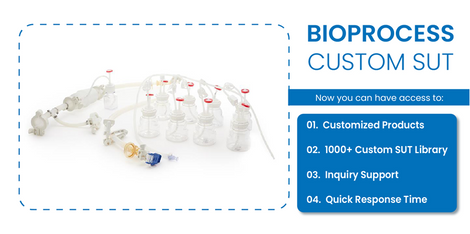
For workflows requiring a specific combination of tubing, connectors or assembly components, explore Foxx's custom single-use bioprocess solutions.
Why Choose Foxx Life Sciences for Bioprocess Sampling Assemblies?
Selecting a sampling assembly involves more than choosing a tube size. You also need to consider component compatibility, connection options, sterility requirements and how the assembly fits into your process.
Foxx Life Sciences offers EZBio centrifuge tube assembly configurations in 15 mL and 50 mL formats, with options that can include TPE tubing, pinch clamps, plugs, dip tubes and vent filters. Product configurations and specifications vary, so review the individual product documentation before selection.
Foxx also offers standard and made-to-order single-use bioprocess solutions. Its manufacturing capabilities include ISO 13485 certification and ISO Class 7 cleanroom facilities. These capabilities support customers evaluating single-use components and assemblies for their process requirements.
Frequently Asked Questions
1. What is a centrifuge tube assembly used for in bioprocessing?
A centrifuge tube assembly can support bioprocess sampling and fluid transfer workflows. Depending on its configuration, it may include tubing, connectors, clamps, plugs and other components for handling process samples.
2. What sizes are available for EZBio centrifuge tube assemblies?
Foxx offers EZBio centrifuge tube assembly configurations in 15 mL and 50 mL formats. Check the individual product listings for available configurations.
3. Why is polypropylene used in centrifuge tubes?
Polypropylene is commonly used because it offers useful chemical resistance and is suitable for many laboratory applications. Actual compatibility depends on the sample composition and operating conditions.
4. Are all centrifuge tube assemblies sterile?
No. Sterility depends on the specific product configuration. Check the product documentation for its sterile status and sterilization details before use.
5. Is the complete centrifuge tube assembly compatible with centrifuge operation?
Not necessarily. Confirm the approved centrifugation conditions and configuration with the manufacturer. A tube intended for sampling or fluid transfer should not automatically be treated as an assembly approved for centrifugation.
Choose the Right Assembly for Your Workflow
The right centrifuge tube assembly depends on sample volume, material compatibility, connection requirements, sterility and operating conditions. Reviewing these factors before selection can help you identify a configuration that fits your bioprocess sampling workflow.
Explore Foxx Life Sciences' EZBio centrifuge tube assembly range to review available configurations and product specifications.